25 Crossword Puzzles 6: A Practical Guide to Creating Crossword Puzzle Books on Amazon KDP
Crossword puzzle books remain one of the most steady and reliable niches on Amazon KDP. Readers come back for more, and if you deliver a polished interior, you can build a small but consistent income stream. The challenge is that many new publishers jump in without understanding what makes a puzzle book actually usable. The 25 Crossword Puzzles 6 interior provides a solid foundation for creating a professional book, but how you use it matters just as much as having the puzzles themselves. Let’s walk through what this interior includes, where people commonly go wrong, and how to avoid those missteps so your book stands out rather than blending into the crowd.
What Exactly Is 25 Crossword Puzzles 6?
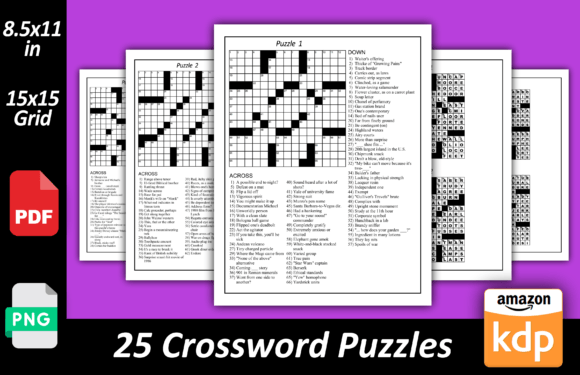
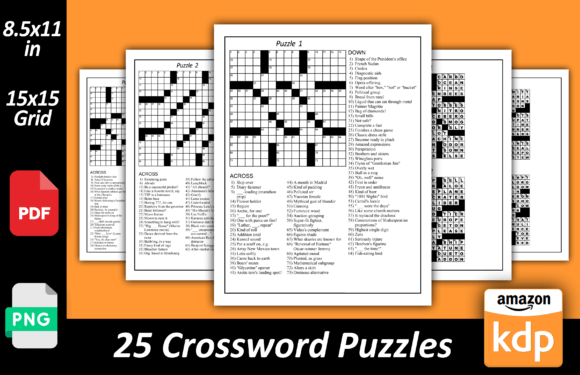
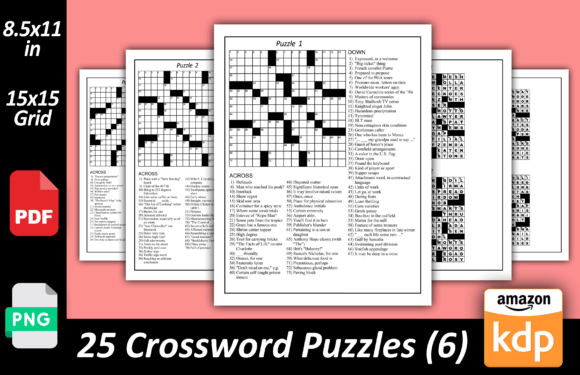
At its core, this is a pre-made interior for a crossword puzzle book. It contains 25 puzzles on a 15×15 grid, using an American crossword style with intermediate to hard difficulty. The package includes both PDF and PNG files, formatted at 8.5 x 11 inches with no bleed, plus a separate solutions section. The design is intentionally clean and unique, so you can drop it into your book without extensive reworking. The real value here is that you get a ready-to-use foundation, but you also have the flexibility to combine multiple volumes to create something distinct.
For anyone looking to publish on KDP, this type of interior saves hours of manual grid creation and formatting. But having good content is only half the battle. The other half is knowing how to present it, package it, and avoid the common pitfalls that lead to returns, low reviews, or poor discoverability.
Overlooking Grid Quality and Design Consistency
One of the most frequent mistakes new publishers make is assuming any puzzle grid is good enough. A 15×15 grid might look straightforward, but if the numbers are poorly placed, the clues don’t align well with the grid, or the visual spacing feels cramped, readers notice immediately. The 25 Crossword Puzzles 6 interior uses an American crossword format, which means the grid is symmetrical and the clue numbering follows standard conventions. That matters because solvers expect consistency.
When you choose a puzzle interior, check that the grid numbering is clear and that the clue list is easy to scan. A well-designed grid reduces eye strain and makes the solving experience enjoyable. If you mix puzzles from different sources without checking alignment, you risk creating a book that feels disjointed. Stick with interiors that maintain the same grid size, numbering style, and clue formatting throughout.
Another overlooked detail is the no bleed requirement. For an 8.5 x 11 inch book, no bleed means the content stays safely within the printable area. If you add background images or decorative borders without checking the margins, you might accidentally clip puzzle edges or clue text. The pre-formatted PDF in this interior already handles that, so you avoid that mess entirely.
Ignoring the Solutions Section Layout
The solutions section is where many publishers lose credibility. A common mistake is to cram all solution grids at the end without clear labeling, making it frustrating for users to find the answer to puzzle 14. The 25 Crossword Puzzles 6 interior includes a dedicated solutions section, but how you present it matters.
Make sure each solution grid is clearly labeled with the puzzle number and, if possible, a matching header style. Avoid placing solutions on the same page as clues or other content. Readers appreciate being able to flip to the back and quickly locate the answer they need without scanning through unrelated material. If you combine multiple volumes, keep the solutions section for each volume separate or clearly delineated so there’s no confusion.
Also, consider the visual quality of the solution grids. If you use PNG files, ensure they are high resolution and that the numbers are legible when printed. A blurry solution page looks unprofessional and can lead to negative reviews. The PNG files included in this interior are designed to be print-ready, but always preview them in a print simulator before uploading to KDP.
Misunderstanding the “Mix and Match” Opportunity
One of the biggest advantages of a pre-made interior like 25 Crossword Puzzles 6 is that you can combine it with other volumes to create a unique book. Yet many publishers either use it exactly as is or try to mix incompatible puzzle styles. The result is a book that feels generic or inconsistent.
To make your book stand out, consider pairing this intermediate-to-hard set with another volume that offers a different difficulty or a themed variation. For example, you might combine 25 puzzles at an intermediate level with 25 easier puzzles to create a gradual progression within one book. Or you could pair it with a volume that uses a different grid size or puzzle type, such as word searches or cryptograms, to offer variety. The key is to ensure the formatting remains consistent—same page size, same margin treatment, same clue styling—so the book feels cohesive.
Another approach is to create a series. Instead of one book with 50 puzzles, publish multiple volumes, each with a unique subtitle indicating the difficulty or theme. This builds a catalog that readers can follow. Just be careful not to duplicate puzzles across volumes unless you clearly label them as different editions.
Skipping the Audience Fit Check
A crossword puzzle book with an intermediate-to-hard difficulty level targets a specific reader. That reader is likely an experienced solver who enjoys a challenge and has some familiarity with American crossword conventions. But if you market this book to casual solvers or beginners, you will get complaints that the puzzles are too hard. Conversely, if you position it as a beginner book, advanced solvers will skip it.
Before you publish, look at the clue examples in the interior. Are they general knowledge, pop culture, or specialized vocabulary? Make sure your book description accurately reflects the difficulty. Use phrases like “intermediate to hard,” “for experienced solvers,” or “challenging 15×15 grids” so readers self-select correctly. If you blur the difficulty level to attract more clicks, you’ll end up with returns and low ratings.
Also consider the age range. Adults aged 20–50 who enjoy crosswords tend to appreciate clever clues and a clean layout. Avoid adding childish fonts or overly decorative elements. Simplicity and readability win in this demographic. The 25 Crossword Puzzles 6 interior uses a straightforward design, which is exactly what this audience expects.
Neglecting the Book Interior Beyond the Puzzles
A puzzle book is more than just the puzzles. You need a title page, a copyright page, a table of contents, and possibly an introductory note. Many publishers skip the table of contents for puzzle books, but it helps readers navigate, especially if the book contains multiple sections or difficulty levels. For a book with only 25 puzzles, a table of contents might seem unnecessary, but if you add an introduction explaining the puzzle style or offering solving tips, you create a more polished product.
Also, consider adding a “How to Use This Book” page if the puzzle style might be unfamiliar to some readers. Even experienced solvers appreciate a quick reference on clue numbering or grid notation. Small touches like these increase perceived value and reduce confusion.
Another detail: ensure the PDF and PNG files are compatible with KDP’s upload requirements. The 25 Crossword Puzzles 6 interior is formatted with no bleed at 8.5 x 11 inches, which is a standard trim size. Double-check that your book interior file includes all necessary pages and that there are no blank pages or missing sections. KDP’s previewer will catch most issues, but it is better to review everything before uploading.
Underestimating the Importance of Cover and Description
Even the best puzzle interior will not sell if the cover looks amateurish. Your cover should communicate that the book contains challenging, American-style crosswords. Use imagery that evokes intelligence, relaxation, or mental stimulation. Avoid clutter. A clean cover with a readable title and a subtitle indicating the difficulty level works best.
The book description is equally important. Do not just say “25 crossword puzzles.” Explain what makes this book different: the grid size, the difficulty, the unique design, the lack of bleed, the included solutions. Mention that the puzzles are suitable for adults and that the book can be used for travel, relaxation, or daily mental exercise. Use bullet points sparingly, but a short list of features helps scanners understand what they are getting.
Also, consider adding a note about the puzzle style. If your puzzles include a mix of themes or a specific cultural focus, mention that. Readers searching for American crosswords want to know they are getting the real thing, not a generic grid.
Overpricing or Underpricing Based on Volume
A book with 25 puzzles is smaller than a typical 100-puzzle collection. That is fine, but you need to price accordingly. If you price it like a full-length puzzle book, readers will feel they are not getting enough value. On the other hand, if you price it too low, you devalue your work and may struggle to cover costs.
Look at comparable puzzle books on Amazon to see what the market expects for a 25-puzzle book. Generally, a smaller volume can be priced between $5.99 and $8.99, depending on the quality of the interior and the cover. If you combine multiple volumes into a larger book, you can justify a higher price. The key is to match the price to the perceived value. A well-designed interior with clean grids, clear solutions, and a professional cover can command a higher price than a sloppy one, regardless of puzzle count.
Remember that KDP royalties vary by pricing tier, so factor that in. A $6.99 book on the 70% royalty tier for US sales gives you a decent margin. Test different price points with Amazon’s pricing tools, but start within the expected range to avoid discouraging initial sales.
What to Check Before You Hit Publish
Before you upload your final file, run through a quick checklist. First, verify that the PDF and PNG files are complete and that the solutions match the corresponding puzzles. Second, check that all text is legible at actual size. Third, ensure there are no stray marks, missing numbers, or formatting inconsistencies. Fourth, preview the book on KDP’s online previewer to see how it looks on different devices. Fifth, ask someone else to solve one or two puzzles from the printed proof to catch any errors you might have missed.
If you are using the 25 Crossword Puzzles 6 interior as part of a larger collection, double-check that the puzzle numbering is sequential across all sections and that the table of contents reflects the correct starting pages. Small errors like these can frustrate readers and lead to negative feedback.
Final Thoughts on Building a Strong Puzzle Book
Creating a successful crossword puzzle book on Amazon KDP is not about having the most puzzles or the cheapest price. It is about delivering a polished, usable, and enjoyable experience for the solver. A pre-made interior like 25 Crossword Puzzles 6 gives you a strong starting point, but the real work lies in how you present it, market it, and combine it with other content to create something that feels both professional and unique. Avoid the common mistakes of inconsistent formatting, poor solution layout, mismatched difficulty marketing, and neglected book details. Pay attention to the small things, and your puzzle book will earn its place in a competitive but rewarding niche.