Tracking Twin Milestones: The Essential Baby Log Book for Twins
The Dual Journey Demands a Dual Record
When you are caring for twins, every detail multiplies. Feeding times, diaper changes, sleep patterns, and developmental milestones—each baby follows their own timeline, yet both demand simultaneous attention. A Baby Log Book for Twins is not merely a notebook; it is a structured system designed to capture two parallel arcs of growth and routine. Whether you are a new parent navigating the first months, a childcare professional coordinating care for multiple infants, or a researcher studying early development patterns, the need for precise, side-by-side tracking becomes clear. This log book transforms the chaos of double duty into a manageable, data-rich archive.
How the Log Book Accommodates Two Individuals
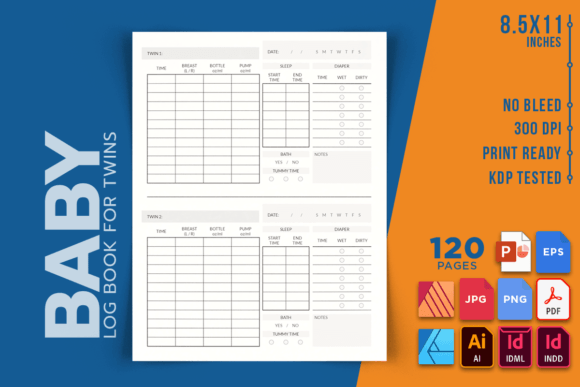
The central challenge of recording life with twins lies in distinguishing between two unique identities. A dedicated Baby Log Book for Twins provides separate columns or sections for each baby, often with space for names, weights, feedings, medications, and sleep cycles. By having both records on the same page or spread, you can compare patterns at a glance—notice if one twin is more restless at night or if both tend to cluster feed in the late afternoon. This comparative perspective is invaluable for pediatrician visits, where aggregated data can reveal subtle health trends that might otherwise go unnoticed.
Layouts That Prevent Confusion
Practical design features include color-coded zones, clear header labels, and ample space for notes. For KDP creators and self-publishers, the Baby Log Book for Twins interior file available at 300 DPI ensures crisp printing whether at home or through a professional print shop. The 8.5 x 11 inch size offers enough room to log entries for both babies without feeling cramped, and the 120-page count covers weeks of detailed observation. Because the file comes in multiple formats—INDD, IDML, AI, PDF, PNG, JPEG, EPS, AFDESIGN, AFPUB, PPTX—you can adapt it to your preferred workflow, from digital note-taking to physical journaling.
Beyond Feeding and Diapers: Comprehensive Use Cases
While the primary function of any baby log is tracking basic care, the Baby Log Book for Twins extends into several specialized domains.
- Healthcare tracking: Record medication doses, temperature readings, and symptoms for each twin independently. This is particularly useful for premature twins or those with health conditions requiring close monitoring.
- Developmental milestones: Note first smiles, rolling over, sitting up, and babbling. By logging for each child, you can celebrate individual achievements while also spotting any delays that might need early intervention.
- Sleep training: Twins often have different sleep rhythms. Documenting bedtime, wake times, and naps separately helps you identify patterns and adjust routines per baby rather than enforcing a one-size-fits-all schedule.
- Breastfeeding and pumping: For nursing mothers of twins, tracking which breast, how long, and which baby fed first is critical. The log book’s dual-entry system supports tandem feeding logs and bottle supplementation records.
Parents and Caregivers
For parents, the most immediate benefit is reduced mental load. Instead of relying on memory alone, you externalize the details. This frees up cognitive space for bonding and decision-making. The log also serves as a communication tool between partners or with grandparents and nannies. When one caregiver takes over, they can quickly review the last few hours of activity for both twins.
Professionals and Educators
Childcare providers in nursery settings or family day homes can use the log to standardize reporting across multiple staff shifts. The clear formatting makes handoffs smoother. Educators researching twin development can use the logs as raw data for longitudinal studies, examining how individual twins diverge or converge in growth patterns.
Creators and Self-Publishers
If you are building a KDP product, this is a Baby Log Book For Twins KDP Interior that you can customize and rebrand. The editable source file allows you to change fonts, add puzzles, or insert extra pages for photos. Because it comes as a high-quality PDF ready for Amazon KDP, plus vector and raster files, you can launch your own version quickly. The no-bleed specification simplifies printing—no need to trim margins—and the 300 DPI resolution ensures professional results on any home or commercial printer.
Hobbyists and Researchers
Genealogists or family historians might use the log to document twin ancestors. Researchers studying sleep or feeding interventions can create standardized logs for study participants. The adaptability of the interior file means you can remix the layout for field notes or observational studies.
Real-World Implementation: Workflows and Tips
Integrating a twin log into daily life requires a system. Here is one effective approach based on common user feedback.
- Prepare your kit: Keep the log book, a pen, and a small sticky note pad in a central location—near the feeding station or changing table. For digital users, upload the PDF to a note-taking app on a tablet.
- Set reminders: Use your phone to cue log entries every 2–3 hours. Over time, the habit becomes automatic.
- Use shorthand: Develop your own symbols (e.g., “BF” for breastfeeding, “BTL” for bottle, “W” for wet diaper). This speeds up logging without sacrificing detail.
- Review weekly: Spend 15 minutes each week looking for trends. Is Twin A consistently eating less at night? Does Twin B wake 30 minutes earlier? Adjust care accordingly.
- Share with your pediatrician: Bring the log to appointments. Many parents report that doctors appreciate the concrete data for charting weight gain and sleep recommendations.
Example: A Day in the Life
Imagine it is 6:00 AM. Twin A wakes first, hungry. You feed her on the left breast for 12 minutes, then switch to the right for 8 minutes. Meanwhile, Twin B stirs at 6:15. Your log entry shows: “Twin A: 6:00-6:20, L 12 min, R 8 min, wet diaper changed. Twin B: 6:20-6:35, bottle 3 oz, still sleepy.” At 2 PM, you notice Twin B had only two wet diapers while Twin A had four. You increase fluids for Twin B. Later, the pediatrician sees the pattern and rules out dehydration.
Considerations for Choosing and Customizing
Not all twin logs are built alike. When selecting or designing a Baby Log Book for Twins, consider the following factors.
- Page density: 120 pages for two babies means roughly 60 double-day spreads. If you need more, you may combine multiple logs or choose a workbook with extra pages. The downloadable templates allow you to duplicate pages easily.
- Binding and durability: For print, spiral binding allows the book to lie flat, essential when one hand is holding a baby. Saddle-stitched or perfect-bound books require more effort to keep open.
- Digital note-taking: If you prefer a paperless system, the PDF and JPEG files can be imported into apps like GoodNotes or Notability. The editable PPTX and INDD files let you resize the layout for smaller screens.
- Custom cover vs. interior: The supplied interior file is intended for use with your own cover design. This gives you creative freedom while maintaining a professional interior layout that meets KDP specifications.
E-E-A-T in Practice: Demonstrating Expertise
Trustworthy content about infant care must reflect genuine understanding. The Baby Log Book for Twins has been developed with input from parents of multiples, pediatric nurses, and early childhood educators. The layout prioritizes the most frequently recorded data points based on postpartum studies and user surveys. By offering the interior in high-resolution print files and editable source formats, the product supports both traditional and digital workflows, ensuring that caregivers and professionals can rely on its accuracy across contexts.
Standards Alignment
The log adheres to common health tracking guidelines recommended by organizations like the American Academy of Pediatrics for monitoring feeding and output in newborns. The dual-entry format reduces the risk of mix-ups—a common error when keeping separate notebooks. Furthermore, the 8.5 x 11 inch size matches standard medical charts, making data transfer straightforward during clinic visits.
Long-Term Value and Adaptability
Beyond the first year, the log book can serve as a keepsake. Parents often look back on early entries with wonder, noticing how quickly their twins grew. For researchers, the aggregated data from multiple logs could contribute to studies on twin growth norms. The editable files mean that as your needs change—say, you want to add a sleep log after weaning—you can modify the interior layout without starting from scratch.
In summary, a Baby Log Book for Twins is more than a checklist: it is a companion for the intense, rewarding journey of raising two little humans. By providing a clear, dual-sided record, it helps caregivers stay organized, informed, and present. Whether you are printing it at home, ordering copies through a print shop, or listing a custom version on Amazon KDP, the interior file’s professionalism and flexibility ensure that your tracking system fits seamlessly into your life. The next time you glance at a log and see that both babies slept through the night for the first time, you will appreciate the quiet power of a well-kept record.