50 Mazes with Solutions for Adults: A Detailed Look at the Hard Maze Collection for Amazon KDP Publishing
Maze books for adults have grown into a distinct niche within the activity and puzzle market. While many consumers seek relaxation through simple puzzles, a substantial audience craves genuinely hard challenges that test spatial reasoning and patience. The 50 Mazes with Solution for Adults collection targets precisely this group, offering a set of 50 mixed‑cell mazes with an unusual variety of shapes and grid types. For anyone evaluating options—whether you are a KDP publisher, a puzzle designer, or an adult who simply enjoys difficult mazes—understanding what this product delivers and where it fits among other choices can help you decide if it matches your needs.
What Makes This Maze Collection Distinct?
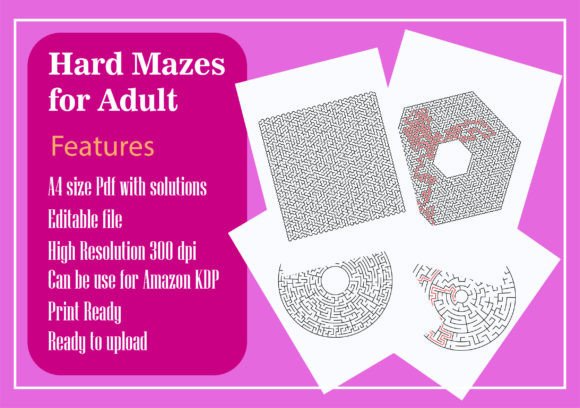
At its core, the collection provides 50 distinct mazes that break away from the traditional square‑grid format. Instead, it blends hexagonal cells, triangular cells, and square cells in a single book. The outer shapes of the mazes vary as well: circular, rectangular, (sometimes square), hexagonal, and triangular borders. This combination is relatively rare. Most maze books stick to one cell type (usually square) and one shape (rectangle). The inclusion of multiple geometries offers more variety within a single volume, which can keep a solver engaged over 50 puzzles.
All mazes are rated as hard, meaning they require careful planning and often benefit from pencil‑and‑paper trial runs. Each maze comes with a solution, placed at the end of the PDF. The product is designed for large‑print use (A4 size, no bleed), making it suitable for adults who prefer bigger grids and for teenagers who are still developing fine‑motor control. The file is also editable, which is a key feature for publishers who want to tweak fonts, add branding, or adjust margins before uploading to Amazon KDP.
Comparing Cell Types and Maze Shapes
The most common maze books for adults use square grids inside rectangular outlines. That format works well because most people are familiar with it, and square cells fit neatly on standard pages. However, hexagonal and triangular cells change the movement rules: diagonal moves are often allowed (or disallowed based on the cell design), and the path‑finding demands different strategies. For example, a triangular‑cell maze forces the solver to consider up to three possible exits from each triangle, which can feel more disorienting than a square cell’s four orthogonal directions. Hexagonal cells offer six possible directions, which increases branching complexity.
This collection’s mix of shapes—circular, rectangular, hexagonal, and triangular—adds another layer. A circular maze with hexagonal cells, for instance, creates a non‑rectangular bounding area that physically restricts where paths can go. For a solver, this can be refreshing compared to the usual rectangle. For a publisher, it means offering a product that stands out visually on a bookshelf thumbnail. If your typical listing shows rows of identical rectangular‑grid mazes, this variety may attract buyers who are bored with the same format.
Still, the diversity has tradeoffs. Some solvers prefer consistency—they want to settle into a rhythm with one grid type and one shape. A book that constantly switches may feel less cohesive. If your audience is a wide group of adults (including seniors), the abrupt changes could be frustrating. But for the segment that craves novelty and challenge, the variation is a strength.
Strengths of the 50‑Puzzle Format with Solutions
Every maze in this book includes a solution. That is a major factor for many buyers. Some adult maze books leave solutions out, arguing that looking ahead spoils the challenge. Yet for a hard maze, having a solution serves several practical purposes:
- Self‑checking – If you get stuck, you can peek at the solution to see where you went wrong, then continue without restarting.
- Learning – Advanced solvers can study the solution’s logic, understanding why a particular path worked.
- Reducing frustration – Hard puzzles can become discouraging; a solution provides a safety net.
Additionally, the large‑print A4 size with no bleed makes the mazes readable without eye strain. Many adult puzzle books use small grids that require squinting. This format is particularly valuable for older adults (50+) who may have mild presbyopia. The editable PDF also allows you to enlarge fonts for maze labels or instructions, or even convert the file to another trim size while preserving the no‑bleed layout. For KDP publishers, that flexibility reduces prepress headaches.
The “hard” difficulty is consistently applied across all 50 mazes. There is no progression from medium to extreme; every puzzle demands attention. If your target buyer wants a single‑difficulty book for consistent engagement, that is perfect. If they prefer gradual difficulty scaling, they may look elsewhere or combine this book with an easier collection.
Where This Product Fits vs. Other Options
If you are comparing this collection to what else is available, consider a few categories:
Single‑cell‑type books – Most maze books are all‑square grids. These are simpler to design and often cheaper. If a buyer wants the cheapest maze book possible, a basic 100‑square‑grid book may win. However, the mixed‑cell approach offers more cognitive variety for about the same price point.
Maze books without solutions – Some purists argue solutions encourage cheating. If your audience is strictly competitive or wants to test themselves without a crutch, a no‑solution book might be preferable. But for the broader adult market, solutions are a safety feature that reduces returns and negative reviews.
Large‑print vs. standard print – Standard print maze books (around 6″x9″) are portable but have tiny grids. This A4 collection is ideal for home use, waiting rooms, or tabletop solving. It is less convenient for travel. If portability is top priority, a smaller, ultra‑compact maze book might be better.
Editable vs. fixed PDF – Most KDP maze books are sold as fixed PDFs. An editable version is rare. For a publisher who wants to customize (change colors, add a brand logo, adjust line thickness), the editable file saves hours of redesign time. For a consumer, the editable file is irrelevant because they will only see the final printed version.
Hard‑only vs. mixed difficulty – Some books combine easy, medium, and hard mazes to appeal to a wider audience. This collection is all hard, which will delight hardcore solvers but might intimidate casual buyers. If you target an audience that is new to mazes, a mixed‑difficulty book may be a safer bet.
Tradeoffs and Limitations to Consider
No product suits every scenario. The 50 Mazes with Solution for Adults has a few limitations worth weighing:
- Only 50 puzzles. Some adults burn through mazes quickly. At 50 puzzles, the book may feel thin compared to 100‑puzzle competitors. However, the hard difficulty prolongs solving time; an experienced solver might spend 10–30 minutes per maze, yielding 8–25 hours of total engagement. Still, if buyers measure value by puzzle count, a 50‑puzzle book could lose out to a 100‑puzzle one.
- No progressive challenge. Because every maze is hard, there is no warm‑up or cooldown. Some solvers like to start with easier puzzles to build confidence. If that describes your audience, a collection with gradual difficulty might be more satisfying.
- Large format may be cumbersome. A4 size (roughly 8.27″ × 11.69″) is bigger than typical trade paperbacks. It does not fit in a standard purse or jacket pocket. For solving at a desk or table, it is great; for bus commutes, less so.
- Requires basic editing skills for customization. The editable PDF is a boon for publishers who know how to use editing software. For an author who expects a ready‑to‑upload file, the “editable” tag may create confusion if they think they need to edit something. Clear instructions about what “editable” means (fonts, layout, etc.) are helpful.
Best‑Fit Situations
This collection shines in specific use cases:
- You are an Amazon KDP publisher looking for a low‑effort, high‑quality maze book that stands out from the sea of square‑grid products. The mixed cells and shapes give you a unique selling point. The editable PDF lets you rebrand or resize easily.
- You are an adult or teen who loves hard puzzles and enjoys exploring different maze geometries. If you already have several square‑grid books and want something new, this collection offers that change.
- You need a large‑print puzzle book for seniors (or for yourself) who prefer bigger grids. The A4 no‑bleed layout ensures clear, readable paths.
- You want a gift for a puzzle enthusiast who values solutions. Including solutions reduces the risk of the book being dismissed as “too hard” and thrown aside.
When You Might Prefer Something Else
On the other hand, consider alternatives if:
- You want a pocket‑sized travel puzzle book. Look for a smaller trim size (e.g., 6″×9″ or 5″×8″) with a compact layout.
- You are designing a maze book for stress relief or meditation. Simple, repetitive mazes with wide paths and no time pressure are more appropriate. Hard mazes can cause frustration, not relaxation.
- You need a high‑volume puzzle collection (200+ mazes) for a low‑price KDP book. This 50‑puzzle set would need to be combined with other volumes to reach that count.
- You are a purist who believes solutions spoil the challenge. There are plenty of unsolved maze books on the market; choose one without an answer key.
Practical Comparison: Two Examples
Imagine two prospective buyers:
David is a 45‑year‑old software engineer who loves logic puzzles. He has bought several square‑grid maze books and found them repetitive. He wants something that forces him to think in new ways. The 50 Mazes with Solution for Adults is a good match for David because the hexagonal and triangular cells introduce new movement rules, and the circular and hexagonal shapes break the visual monotony. He appreciates having solutions to verify his work and doesn’t mind a large format.
Maria is a 60‑year‑old retiree who enjoys mazes as a relaxing pastime. She finds hard puzzles overwhelming and prefers mazes she can complete in a few minutes. A book of all‑hard, mixed‑cell mazes could frustrate her. She would be better served by a collection of easy to medium square‑grid mazes in a large‑print format without the complexity of hexagonal paths. For Maria, a different product—perhaps one with simple rectangular‑grid mazes and solutions—would be more appropriate.
These examples illustrate that no single maze book works for everyone. The key is matching the product’s features (cell types, difficulty, shapes, format) to the end user’s preferences and goals.
Making an Informed Decision
When evaluating the 50 Mazes with Solution for Adults, focus on your own priorities or those of your target audience. Are you or your customers looking for something different? Do they need large print? Is editable flexibility important? If the answer to several of these is yes, this collection is a strong candidate. If the answer leans toward traditional formats, easier puzzles, or smaller size, then other options may serve better.
A well‑chosen maze book can provide hours of focused mental stimulation without the addictive pull of screens. Whether you are compiling a KDP catalog or buying for personal use, understanding the tradeoffs between variety and cohesion, difficulty and relaxation, format and portability will guide you to the right choice. The mixed‑cell, mixed‑shape approach of this product is not for everyone, but for those who welcome a break from the ordinary, it delivers a genuinely hard and varied solving experience.